Chatbots · website, Telegram, WhatsApp, CRM

You already had a chatbot. It asked "How can I help?" and on the second question it broke

That ₽15,000 bot is a button menu. A customer asks a question in their own words, the bot says "sorry, I didn't understand," and the customer walks off to whoever answered. An AI chatbot for business works differently: it reads questions in plain language, answers from your policies and price list, qualifies leads, books appointments, and follows up on people who go quiet. In the law-firm case study, response time to an inquiry is 30 seconds and lead loss dropped from 60% to 15%. In the online-school case study, 86% of questions are closed without a human. Start with a free breakdown: we'll look at your conversations and calculate how much you're losing on response speed.

Get a free consultation
Case-study response time
30 sec instead of hours
Questions closed by the AI bot
86% without a human
Breakdown and ROI calculation
₽0, 14 days
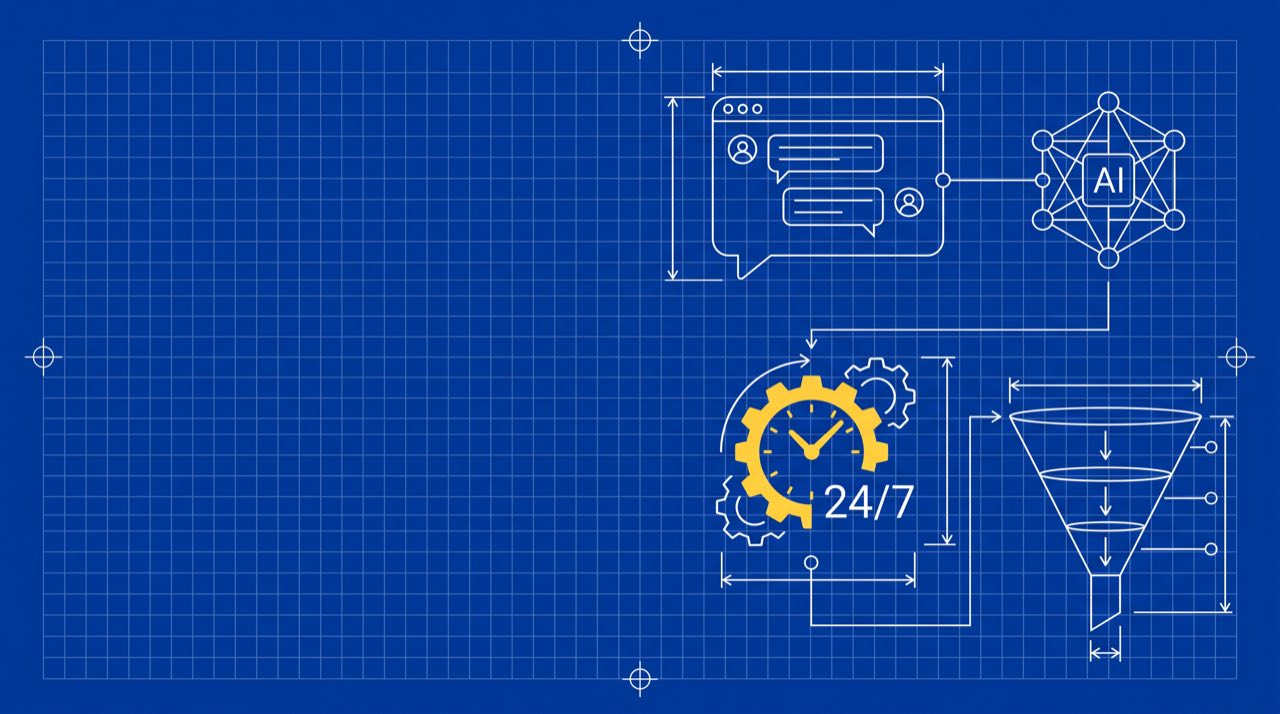
Chatbots · website, Telegram, WhatsApp, CRM — AI implementation diagram
01Sound familiar?

Open your website chat and see what happens there after six in the evening

Someone landed on your site at 9:40pm, read two pages, opened the chat, and asked about timelines and price. The widget showed them a form: "leave your contact info, we'll get back to you during business hours." They closed the tab and, a minute later, asked the same question to a competitor who answers instantly. You already paid for that visit — through ads, SEO, your marketer's time. Paid for it, then gave it away.

During the day the picture is different, but the money is the same. A rep replies twenty minutes later because they were on another call. In those twenty minutes the interest cooled: the customer kept browsing, found three alternatives, and is now comparing you to them instead of choosing you outright. First-response speed isn't service or politeness — it's conversion. In the personal-bankruptcy law firm case, cutting response time to 30 seconds raised paid conversion from 15% to 35% and cut lead loss from 60% to 15%.

And third: half of what your rep types is the same text over and over — how to pay, is there delivery, do you work with VAT, how much does a site visit cost. You're paying a salary for copy-paste, your rep burns out on it faster than on complex deals, and the one genuinely hot lead gets neither their time nor their energy.

02The cost of inaction

How much are you losing while you read this page

Other people's numbers won't help here — run yours. Plug in how many inquiries you get per day, what share you lose before you can reply, and what one deal is worth. The calculator shows the rough amount your business is handing over to silence in the chat.

Lost revenue per month per year —

A rough estimate based on your inputs — we calculate exact numbers on a free consultation.

Get this money back
03How it will be

What your evenings look like when your website bot actually works

You're having dinner with your family, and on your site a real conversation is happening. Someone asks about timelines — the bot answers from your price list and policies, not with generic phrases. They ask something that isn't in the knowledge base — the bot honestly says it'll check with a specialist, takes their contact info, and puts a task on your rep's desk for the morning. Along the way it finds out what matters: volume, budget, city, urgency — and sorts leads into hot and "in six months" itself, right in your CRM. Someone messaged and went quiet for two days — the bot follows up on its own, with no reminders from you. In the morning you don't open a hundred unread messages, you open a summary: this many conversations, this many the bot closed, here are five inquiries that need a human, and here's what people got stuck on most this week. Your sales team works deals — not an autoresponder.

Right now
Chat question at 9:40pm"we'll reply during business hours" form
Routine questions on price and timelinesrep types it out by hand
Customer messages, then goes quietnobody follows up
Leads in the CRMdumped in a pile, sorted by hand
With AI
Chat question at 9:40pmreply in 30 seconds, around the clock
Routine questions on price and timelinesbot answers from your data, rep takes the complex stuff
Customer messages, then goes quietbot follows up automatically on schedule
Leads in the CRMqualified and sorted by priority
04How it works

Three steps, and you don't write a single line of code

  1. 01 · Step 1 · 14 days · ₽0

    Conversation breakdown and automation map

    We pull your real message history from the past month — website, Telegram, WhatsApp, email — and run the numbers: what share of questions is routine, how much time reps spend repeating themselves, and exactly where the chain breaks between an inquiry and a payment. We look at what's already in place: CRM, widget, telephony. The output is a document: which bot scenario pays off first, what effect to expect, and which metrics we'll use to check it.

  2. 02 · Step 2 · pilot · from ₽90,000

    Pilot bot on one scenario

    Not "a bot for everything" — one narrow area where the losses are obvious: first-response consultation on your site, lead qualification, or booking. We train the model on your price list, policies, and message archive, and set hard boundaries: what the bot says on its own and what it must hand off to a human. We connect it to your CRM and messengers. We launch on live traffic alongside your reps and compare against a control group.

  3. 03 · Step 3 · turnkey · custom quote

    Bot across every channel, plus ongoing management

    We expand to website, Telegram, WhatsApp, and Avito — with shared memory, so customers don't repeat themselves when they switch channels. We add follow-up sequences for silent leads, booking, reminders, handoff of hot leads to reps with a ready-made conversation summary, and a weekly digest for the owner. From there we keep it running: retraining on new questions, cleaning up errors, and updating it for new products and prices.

05Proof

Law firm: 30-second response time, lead loss from 60% to 15%, plus ₽3M a month

Edemium case study · personal bankruptcy

A personal-bankruptcy law firm: paid traffic, inquiries from website chat and messengers, a phone-based sales team

The stated problem sounded like a complaint about reps: inquiries were handled slowly, some got lost. We measured it — 60% were being lost. Not because the people were bad at their jobs: inquiries came in through several channels at once, and a rep physically couldn't talk on the phone and answer the chat at the same time. Evening and overnight inquiries waited until morning, and this is a topic where clients decide on emotion, right here and now.

The underlying problem was worse. The owner knew he was pouring ad budget into a leaky bucket but couldn't prove it with numbers and didn't know exactly where it was leaking. Every conversation with the sales team left him feeling like he was being strung along, with no way to check.

He was skeptical about a bot: in bankruptcy, people arrive scared and in debt, and they won't talk to a button menu. We agreed on a narrow experiment — the bot answers first, a rep sees every conversation, and can take it over at any second.

We built an AI bot on the company's policies and message archive: it answers the first questions substantively, finds out the debt amount and situation, filters out non-fits, and hands reps a ready-made breakdown instead of a bare phone number. Result: response time — 30 seconds, lead loss 60% → 15%, paid conversion 15% → 35%, plus roughly ₽3M in revenue a month.

I was sure a bot would scare people off in our field. Turns out, silence is what scares them off. Someone in debt needs to be answered now, not tomorrow at ten in the morning.

Real case, client name withheld under NDA. These numbers belong to this company — yours will depend on your industry, traffic quality, and current funnel state. We'll define exactly what to measure for you on a free consultation.

06While you're thinking it over

A lead who never got an answer doesn't come back for a second try

Losses in the chat are invisible because they leave no trace. A lost customer doesn't write you "I gave up waiting" — they just disappear, and there's no line for them in the report. You see cost per lead and conversion rate, but you don't see a line for "lost while we stayed silent": that line doesn't exist in any CRM. Meanwhile every one of those people was fully paid for by your ad spend, and brought back zero. It gets worse: they didn't disappear into thin air — they went to a competitor, who now got the money, the review, and the repeat sale a year from now. The technology here belongs to no one and isn't secret — the same AI chatbot can go on any website in your industry; the only question is who gets there first. While the customer sees a fast reply from just one in ten, that's your edge. Once everyone starts answering like that, it becomes the minimum bar, and you'll be implementing it not to grow but just to stay in the game. The gap between those two moments is measured in months — and in the deals that, during those months, go to someone else.

07I know what you're thinking

Honest answers to your biggest doubts

I'm being offered a chatbot for ₽15,000. Why pay 90?

For ₽15,000 you get a script with buttons: pre-written branches, and the moment someone steps outside them — "sorry, I didn't understand." It handles hours and addresses fine and falls apart on the first real question. The difference isn't polish, it's three things: the bot understands questions in plain language and answers from your knowledge base, it's connected to your CRM and telephony, and it has hard boundaries with handoff to a human. All of that is work with your data and integrations — not a template thrown together in an evening. If a simple button-based script is genuinely all you need, we'll tell you so honestly on the free consultation and won't charge you a thing.

The bot will start saying nonsense and embarrass us in front of customers

That's the main risk, and it's addressed by design, not by promises. The bot answers strictly from your knowledge base — price list, policies, message archive — and doesn't improvise: anything not in the knowledge base goes to a human. High-stakes topics — money, deadlines, contracts, disputes — are set to mandatory handoff to a rep. During the pilot everything runs under supervision: a rep sees every conversation and can take any of them over in one click, and we review and retrain on any questionable answers.

Our customers don't like bots, they want a real person

Customers don't dislike bots — they dislike dead ends: button menus, the same phrases on repeat, and no way to reach a human. In the bankruptcy case, with the most wary audience possible, the opposite turned out to be true — speed mattered more. We always leave a visible path to a human, and the bot hands off the conversation itself the moment it senses it can't handle it. The customer gets an instant reply, and the complex cases still land with a rep — just with context already attached.

Our site runs on Tilda, our CRM is Bitrix, and we message through WhatsApp. Do we have to rebuild everything?

No. We connect to whatever you already have running: Tilda, WordPress, a custom-built site, Bitrix24, amoCRM, Telegram, WhatsApp, Avito — through a widget, API, and webhooks. Your reps stay in the interface they already know; some conversations simply never reach them, and the ones that do arrive with a ready-made summary. All we need from you is a few meetings and access.

Where does customer data and conversation history actually go?

We work this out at the first meeting and put it in the contract. Options vary: from hosting on your own server, where data never leaves your infrastructure, to Russian cloud models. We anonymize personal data wherever possible, access is role-restricted, and actions are logged. If you have requirements under 152-FZ or an internal security policy, we work within them.

A risk-free pilot for you

We launch the pilot in 2 weeks. You set the success metric yourself. Don't hit it — we refund the pilot. The risk is ours, not yours.

08Cost

How much chatbot development costs, and what to honestly compare it to

One rep handling first-response inquiries: salary plus taxes, vacation, sick leave, and hiring a replacement every few months. Plug in your own numbers and multiply by twelve — that's the annual cost of work where a person mostly answers the same four questions. In the evenings, at night, and on weekends that work doesn't happen at all — and that's exactly when a large share of inquiries come in. The Edemium pilot — from ₽90,000, a one-time cost. For most companies that's less than two months of one rep's salary. The bot answers around the clock, remembers the full price list and every policy, answers a Friday evening question the same as a Monday morning one, and never quits. Don't hit the metric you set — we refund the pilot.
Consultation
₽0Process breakdown + ROI calculation
  • Funnel breakdown and loss points
  • Lost revenue calculated in rubles
  • An honest read on where AI pays off
Get it free
StartScenario pilot
from ₽90,000Payback in 2–4 months
  • Breakdown and automation map — ₽0, 14 days: analysis of your conversations, losses calculated in rubles, choice of first scenario
  • Pilot — from ₽90,000: one bot scenario (consultation, qualification, or booking), trained on your data, integrated with your CRM and messenger
  • Measured against a control group: the difference shows up in numbers — response speed, share closed without a human, conversion rate
Launch a pilot
Turnkey
Custom quoteFull package + ongoing management
  • Turnkey, custom quote: a bot across every channel (website, Telegram, WhatsApp, Avito) with shared memory per customer
  • Follow-up on silent leads, booking and reminders, handoff of hot leads to reps with a conversation summary, a weekly digest for the owner
  • Ongoing management: retraining on new questions, answer quality control, updates for new products and prices
Discuss your project
09FAQ

FAQ on chatbots for business

How is an AI chatbot for business different from a regular button-menu bot

A regular bot runs on a script: a tree of buttons and pre-written branches. Anything not anticipated during setup ends with "sorry, I didn't understand that." An AI bot parses questions asked in plain language, typos and abbreviations included, holds context across the whole conversation, answers from your knowledge base, and can say "I don't know that, let me get a specialist." The practical difference shows up on the second or third reply: where a scripted bot hits a wall, an AI bot keeps the conversation going.

How much does chatbot development cost and what determines the price

A pilot of one scenario starts from ₽90,000. Price comes down to three things: how many tasks the bot handles (just answering questions, or also qualifying, booking, and follow-ups), how many channels we connect (website, Telegram, WhatsApp, Avito), and how complex the integrations with your CRM and telephony are. The process breakdown and ROI calculation are free and take 14 days — we quote the exact price after that, once the scope is clear. Turnkey builds are quoted individually.

Chatbot for small business — does it pay off with low volume

It depends not on company size but on deal value and the share of missed inquiries. With an average order value in the hundreds of thousands, saving one or two deals a month is enough for the pilot to pay off. With five inquiries a day and a thousand-ruble ticket — probably not, and we'll say so directly. That's exactly why the first step is free: you get the answer before spending any money.

Which channels does the bot work in — website only, or messengers too

Both. The website chatbot goes in as a widget, and the same bot runs in Telegram, WhatsApp, and Avito in parallel. The key is shared memory: if a customer starts in the website chat and continues in WhatsApp, the bot remembers the conversation, and the person doesn't have to explain everything again. We choose the channel list based on where your inquiries actually come from, not by adding everything possible.

How long does launch take and what do you need from us

We quote timelines after the process breakdown, once the scope is clear — any number before that would be made up. We need very little from you: access to your chat archive, price list and policies, access to your website and CRM, and one person to answer product questions. We build the knowledge base; your team gets involved at the answer-review stage — usually just a few hours of their time across the whole pilot.

Become the company in your industry that answers in thirty seconds

Look at your competitors through a customer's eyes: message five of them in chat at nine at night and time who replies and when. In most industries the result is the same — a "we'll reply during business hours" form and silence until morning. That's the gap you can walk through right now. In a year, plenty of companies will answer this way, and a fast reply will stop being an edge — it'll become a baseline requirement, without which you simply don't get considered. The question isn't whether you'll get a chatbot — it's whether you'll get one before the company next to you in the search results does.

I want to be first in my industry
10Connection point

Get a breakdown of your conversations and an ROI calculation — ₽0

In 14 days we pull your real conversation history from chat, messengers, and CRM and run the numbers on your data: what share of questions is routine, how many inquiries go unanswered, and what that costs you in rubles per year. The output is a document: which bot scenario to launch first, what it will deliver, and which metrics to check it against. No obligations: want to move forward — we implement it; change your mind — the document stays yours.

Message us on Telegram

Get a free consultation